Should Jurors Bet on Trials?
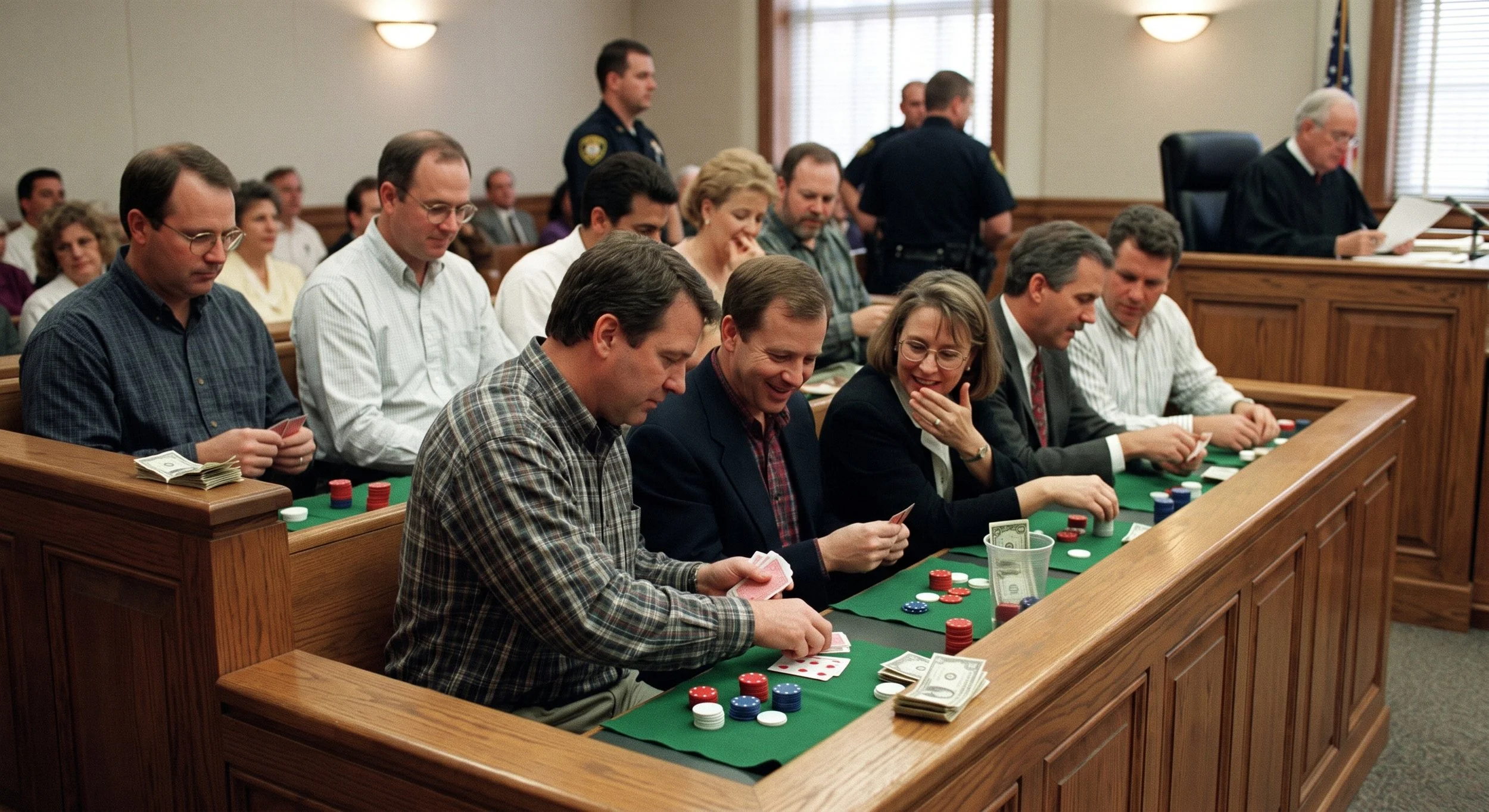
We’ve written recently about juror bribery, typically carried out by attorneys or litigants. Despite what Clarence Darrow might have told you, bribing jurors is unambiguously wrong. Thankfully it appears to be rather rare.
But our current regulatory environment raises the prospect of a different source of juror corruption, and one that might be more difficult to detect or prevent. What if a juror bribed themselves by betting on the outcome of a trial?
Gambling in America has a long and fairly involved history, seesawing between broad acceptance and moral panic or prohibition. Traditionally regulated at the state level, the federal government intervened in 1961 with the passage of the Wire Act. Concerned about the use of gambling proceeds to fuel organized crime, Congress prohibited the use of interstate wires to take or facilitate bets on sporting events.
Congress acted again in the early 1990s in the aftermath of the Pete Rose scandal. Disturbed by the effect that gambling could have on the integrity of sport, Congress passed the Professional and Amateur Sports Protection Act of 1992 (“PASPA”). Somewhat oddly structured, PASPA was designed to prevent the spread of sports gambling by prohibiting states from legalizing it if they had not previously done so. Shortly after its passage, gambling in the United States hit a relative nadir, with Nevada as the only state permitting sports betting, and other gambling largely limited to state lotteries, unpopular parimutuel horse and dog races, and some casino games in Atlantic City.
The tide began to turn with the new millennium. Tribal casinos, contemplated by a Supreme Court ruling in 1976 and brought into a loose regulatory regime by the Indian Gaming Regulatory Act of 1988, gradually evolved beyond bingo parlors and tiny poker rooms to become full on casinos comparable to the offerings in Vegas or Atlantic City. The proliferation of high speed internet, coupled with a brief but widespread televised poker fad, brought on-demand gambling to millions of Americans. And with the erosion of the near total gambling ban, more states and municipalities started looking for ways to cash in, opening exploitative slot machine halls and video poker bars at race tracks, speedways, and other dubious locales.
In 2018 the Supreme Court struck down PASPA in Murphy v. NCAA.[1] PASPA was always a strange law, and it fell in a strange decision, where the Court applied the anti-commandeering doctrine to strike down federal restrictions on state gambling laws. While it seems fairly uncontroversial that the Federal Government could effectively ban sports gambling (either directly because of its impact on interstate commerce or by utterly starving sports betting businesses of any connection to interstate commerce), the Supreme Court effectively said “sure, but the way you did it was bad” and in the process cleared the way for state-regulated gambling on sports essentially everywhere.
But the real death knell to any restraint or regulation of US gambling has been the rise of so-called online prediction markets like Kalshi or Polymarket. These websites offer wagers on virtually everything (but mostly sports) and defy state efforts to prohibit, limit, or regulate them. These companies have found a useful ally in the Trump Administration’s CFTC, which has simultaneously claimed to be the exclusive regulator of these “everything casinos” and simultaneously declined to meaningfully regulate them.
As a result, if you want to bet on the outcome of a high stakes trial, you can. For example, this and this were markets in the recent dispute between Elon Musk and OpenAI. There aren't tons of these bets yet. Trial gambling is a pretty niche activity outside of the biggest cases. But given the explosion in wagering over the last several years and the bizarre bets that are currently taken— such as specific words in the president's speeches—there's every reason to believe that it will increase.
As such, it's worth considering how little stands in the way of a juror placing a wager on the outcome of a trial that they are literally deciding. The online marketplaces don't have ready access to jury lists, even if they cared to police the issue (which is doubtful). Nor does the CFTC have the means, manpower, or motivation to prevent juror gambling. And even if regulators were interested, it would be relatively straightforward for a juror to use a straw man or proxy to avoid easy detection.
Has it already happened? There appeared to be no reported cases of jurors betting on a trial outcome. But we do know that betting markets are notoriously rife with inside betting and attempts at market manipulation. A White House employee was recently terminated after allegedly using access to the president's teleprompter to place bets on the words he would use in speeches. And a journalist reporting on military operations in Israel published a story concerning efforts to manipulate his reporting to alter the results of bets about the war.
And we know that jurors have sought to profit from inside information in the past. In the early 2000s a postal employee in Jersey City was charged with criminal contempt and conspiracy to commit insider trading after passing jury information to traders. Jason A Smith was empaneled on a federal grand jury investigating potential accounting fraud at Bristol Myers Squibb. He learned that several executives were likely to be personally charged with a crime and passed this information to a childhood friend involved in a larger insider trading ring. The conspirators short-sold BMS stock in advance of the expected indictments. They hoped to profit when news of the indicted executives tanked the market price. Ultimately the traders closed out of the short positions after learning from Smith that the executives had been dropped from an updated version of the indictment.
Smith pled guilty and requested a sentence of no jail time in light of his failure to profit from the transaction. Judge Castel of the Southern District of New York, who presided over the prosecution, disagreed, stating during sentencing that “if you breach grand jury security, you will go to jail.” He then sentenced Smith to two years and nine months incarceration.
But while an admirable goal, it is not clear that jailing any juror who bets on a case is fully achievable. In a world where pervasive unregulated Internet vetting makes it possible to discreetly monetize all sorts of previously worthless information, total compliance seems unlikely. Because of this, we do face the prospect that, at least in high-profile trials, jurors may be able to covertly self-bribe in the near future.
How can we address this risk? One obvious solution would be to ban these sorts of wagers on prediction markets. They serve no obvious social value. Anyone who legitimately needed to hedge litigation risk could do so in less corrupting ways. Indeed, liability insurance and litigation financing exist precisely to meet this need. But if regulators will not act, it will likely become necessary for counsel to monitor public prediction markets for wagers relating to active litigation. Courts could also instruct jurors not to wager, though like commonplace “do not Google” and “do not post to social media” instructions it is unclear how effective this will be. In addition, any jury instruction about trial wagering runs the risk of seeding the idea in the brains of jurors who might not otherwise have thought of it.
Is this likely to become a widespread problem? We would certainly hope not. But potential corruption of the justice system is just one more way in which completely unregulated Internet gambling might not be the most sensible social policy.
[1] 584 U.S. 453 (2018).