What Is Embracery?
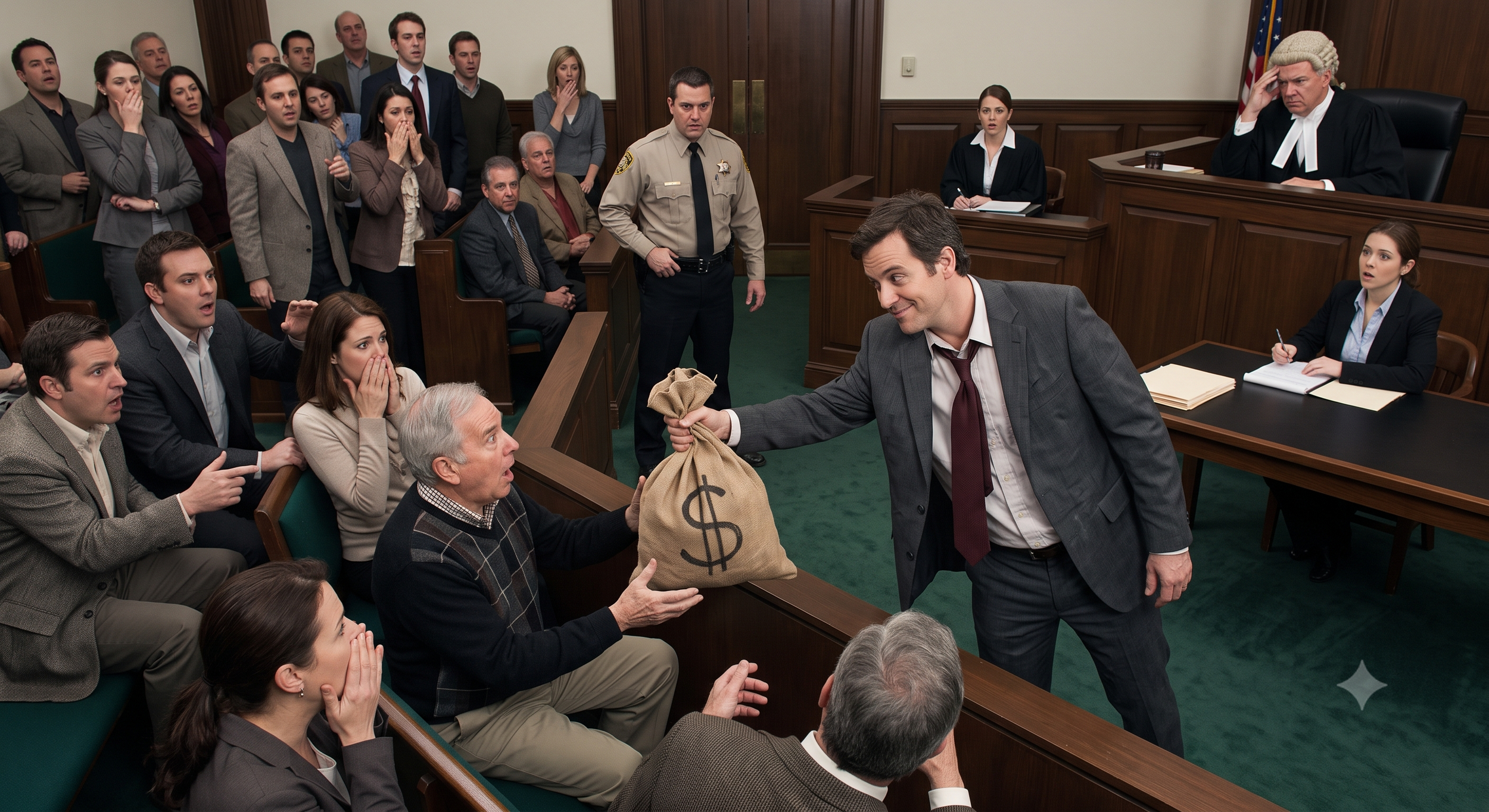
There's an old joke that goes something like this: A lawyer preparing for trial is desperate. His client seems clearly guilty of murder and the prosecution will not offer a plea bargain. In a moment of moral weakness, he offers a juror a bribe—$5,000 if he can get the verdict reduced to manslaughter. The trial goes as expected and the jury is out for deliberation. A day passes, then two, a week—the jury is still undecided. Finally, the jury comes back with a manslaughter verdict.
Relieved, the lawyer speaks to the bribed juror on the way out of the courthouse. “Must have been hard to persuade the others, huh?”
“Yeah,” the juror replies. “They all wanted to acquit him.”
Under the common law, the crime of embracery did not involve awkward hugs, but rather improperly influencing jurors. While the offense is now statutory, in some places a distinct crime and in others a subset of broader prohibitions on bribery, extortion, or obstruction of justice, the principle is essentially unchanged—you aren't allowed to bribe a juror to get the verdict that you want. And as much as embracery is a niche vocabulary word, the basic rule is something that essentially everyone, regardless of sophistication or legal training, understands.
But while this would seem like an obvious, unobjectionable rule, the issue comes up with some frequency. And there is not always agreement either on the moral clarity of the prohibition or the manner in which it is applied. So, with the caveat that you should absolutely not bribe jurors, let's talk about some examples of juror bribery.
The most accomplished lawyer ever accused of bribing a juror is doubtlessly Clarence Darrow. Famous even today for his role in the Scopes Monkey Trial, Darrow is one of the most well-known lawyers in American history, lead counsel in multiple widely publicized “Trials of the Century.” His closing statement in the Loeb & Leopold murder trial is as powerful a defense of a seemingly hopeless cause—two rich kids who murdered a child for fun—as you are ever likely to read. But it was Darrow's actions in another high profile case that led him to being put on trial himself for bribing jurors.
Darrow was a labor lawyer during a time when organized labor was quite literally at war with management. By 1911, he had already obtained an acquittal for union boss William “Big Bill” Haywood, who had been charged with assassinating an Idaho governor by bombing his house. That year, Darrow was hired to defend two other accused union bombers, John and James McNamara. The iron workers were accused of bombing the Los Angeles Times, an anti-labor newspaper, in an attack that killed twenty people. Shortly before trial, Darrow's private investigator, Bert Franklin, was arrested while trying to bribe two jurors just a few blocks from Darrow's office.
It is unclear whether this arrest influenced the defense strategy, but the two defendants pled guilty shortly thereafter. A few weeks later, Darrow was arrested for orchestrating the potential bribes. In an impassioned plea to the jury that pushed very heavily for jury nullification, Darrow denied the charges but also made clear that, given how rotten and unfair the prosecutors had been, he was morally correct to have bribed the jury:
Suppose you thought that I was guilty, suppose you thought so - ... would you dare to say by your verdict that scoundrels like [the District Attorney] should be saved from their own sins, by charging those sins to someone else? ...
Now, gentlemen, I am going to be honest with you in this matter. The McNamara case was a hard fight... . Here was the District Attorney with his sleuths. Here was Burns with his hounds. Here was the Erectors' Association with its gold. A man could not stir out of his home or out of his office without being attacked by these men ready to commit all sorts of deeds. Besides, they had the Grand Jury, we didn't. They had the Police Force, we didn't. They had organized Government, we didn't. We had to work fast and hard. We had to work the best we could, and I would like to compare notes with them.
* * *
Of course, I did not pass $ 500 in the elevator, but if I had, I had just as much right to give that $500 for that purpose as I would have to buy $ 500 worth of hogs, just exactly. I was doing exactly what they were doing, what Burns admitted he was doing, what was done in all their cases, what Sam Browne says they did, when he testified that they filled our office with detectives. And here comes this wonderful man, so honest, so pure, so high, so mighty, [District Attorney] Ford, who says the State has a right to do that, who says the State has a right to put spies in the camp of the "criminal," but the "criminal" hasn't the right to put spies in their camp. Isn't that wonderful, gentlemen? Here is a contest between two parties in litigation; the prosecution has a right to load us up with spies and detectives and informers, and we cannot put anyone in their office. Now, what do you think of that? Do any of you believe it? [1]
Whether this swayed the jury or not we cannot know, but Darrow was acquitted, and a subsequent trial for bribing the second juror deadlocked.
Another seemingly obvious example of juror bribery flew under the radar for some time. This was the practice of repeat defendants giving ostentatiously public gifts to jurors after an acquittal. New York literally changed its juror bribery law after widely circulated reports that wealthy developer Abe Hirschfeld paid each member of a jury that deadlocked on a tax fraud charge against him $2,500.[2]. Why did he do that? Could it have had something to do with the fact that the following week he was facing a murder-for-hire charge? Might he have wanted every potential juror to know that there was an offer on the table? No way to be sure, but the payment was not illegal at the time. In fact, it was reported that Hirschfeld was so confident in the legality of what he was doing that he actually paid the jurors by check.
Famous boxing promoter Don King is also reported to have lavishly rewarded jurors and then disclosed the rewards to the press. [3] In 1998 King took twelve jurors that had acquitted him of insurance fraud on all-expenses-paid trip to the Bahamas and gave them free boxing tickets. And even Oprah Winfrey made news for taking jurors out to lunch after they cleared her in a trial brought by Texas beef producers upset about her statements concerning mad cow disease. [4]
But not everyone gets away with it. A more recent example of accused juror bribery involved former AUSA Paul Bergrin, profiled in the extraordinary New York Magazine Article The Baddest Lawyer in the History of New Jersey. Bergrin, a former prosecutor turned defense lawyer, was ultimately sentenced to six life sentences for racketeering, fraud, and conspiracy to murder a witness. But the New York Magazine reporter was literally able to find a former Bergrin client willing to admit that he “might have fixed a jury or two” for Bergrin, by wandering into the jury assembly room and asking around about who might be interested in making a deal.
I personally watched some of the Bergrin murder trial years ago, and the jurors in that case were kept under extremely close guard on the assumption that there would definitely be attempts to influence them. Whether or not there were is hard to say, but in any event they do not appear to have been successful, given Bergrin’s ultimate conviction.
Under New York law juror bribery is a class D felony under section 215.19 of the Penal Code:
A person is guilty of bribing a juror when he confers, or offers or agrees to confer, any benefit upon a juror upon an agreement or understanding that such juror's vote, opinion, judgment, decision or other action as a juror will thereby be influenced.
Bribing a juror is a class D felony.
In contrast, merely tipping a juror in the manner of a Hirschfeld or Don King is a misdemeanor under section 215.22 of the Penal Code:
A person is guilty of providing a juror with a gratuity when he or she, having been a party in a concluded civil or criminal action or proceeding or having been a person with regard to whom a grand jury has taken action pursuant to any subdivision of section 190.60 of the criminal procedure law (or acting on behalf of such a party or such a person), directly or indirectly confers, offers to confer or agrees to confer upon a person whom he or she knows has served as a juror in such action or proceeding or on such grand jury any benefit with intent to reward such person for such service.
Providing a juror with a gratuity is a class A misdemeanor.
Under federal law, jurors are public officials and any bribery is prosecutable under 18 U.S.C. § 201, which also prohibits bribes to witnesses or senators. Though, given the flexible nature of federal criminal law and DOJ's dim attitude toward the practice, if the US attorney's office finds out that you bribed one of their jurors, they will likely charge you with a dozen other crimes as well.
In cases where the potential for bribery is thought likely—usually ones involving organized crime—there are several precautions that can be taken. Chief among them are jury sequestration and anonymous juries, neither of which is common but both of which are available should the court deem it appropriate. In civil trials there is also the potential for non-unanimous juries, which historically has been offered as a check on bribery since one compromised juror cannot hang the rest.
[1] Gerald Uelmen, Symposium: The Legal Profession: Looking Backward: Fighting Fire With Fire: A Reflection On The Ethics Of Clarence Darrow, 71 Fordham L. Rev. 1543, 1543-44 (Mar. 2003). For another account of Darrow’s two trials, see also Robert Gottsfield, The People v. Clarence Darrow, 44 AZ Lawyer 28 (Nov. 2007).
[2] Erica Summer, Post-Trial Jury Payoffs: A Jury Tampering Loophole, 15 St. John’s J.L Comm. 353, 357-360 (2001).
[3] Id. at 361.
[4] Id.