Do You Want a Non-Unanimous Jury?
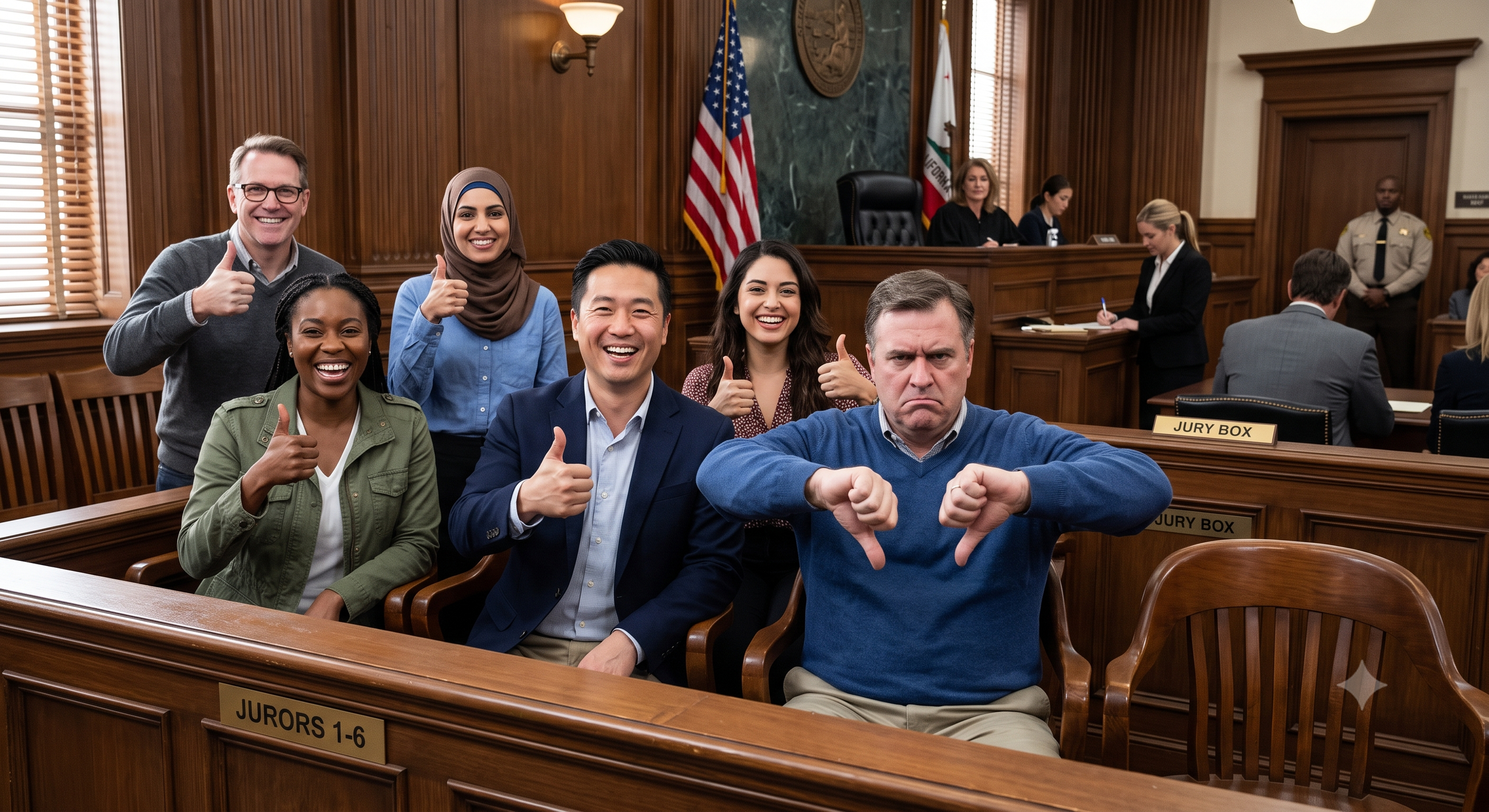
Most juries, most of the time, must reach a unanimous decision. As we've written before, the Supreme Court has played around with exactly how many folks are required to fill out a jury. But no matter what that number is, for all criminal trials and about half of civil trials, everyone on the jury must agree on the verdict. This is deemed to be so important that there are rules that allow you to put every jury member on the spot (“polling the jury”) and force them to say out loud whether they agree with a verdict.
Having grown up with a practice and having seen television and movies depicting jury unanimity, it can be easy to miss just how weird this rule is. While many social interactions utilize consensus as a decision mechanism—if you want a dinner out with friends, everyone has to agree on where—American political institutions are unabashedly majoritarian. From local ordinances to federal statutes, our laws emerge from majorities, not complete agreement. And even within the legal system, appellate courts (from the First Department to the United States Supreme Court) render their decisions by majority vote. Indeed, our culture has an almost perverse fascination with democracy over consensus, even when it comes to things like co-op boards or homeowners associations where consensus might arguably lead to more domestic tranquility and less litigation.
So, given all of this, you may wonder, why are juries (but not judges) often required to be unanimous? And in circumstances where you have a choice, such as civil cases under the federal rules, should you opt for a non-unanimous jury?
The historical origins of juror unanimity are likely lost to time. But the common law rule takes hold in the 14th century and becomes an essentially uncontested feature of jury trials by the time of the American founding. [1] While some of the colonies experimented with non-unanimous juries during the late 17th century, by the time that the constitution was ratified all of the 13 colonies required unanimous juries. [2]
But while there is no legislative history of the common law to walk us through the original purpose of juror unanimity, there are some things that we do know. First, the requirement was not born out of some great desire for thorough deliberation by juries. Prior to the introduction of defense counsel in the 18th century, criminal trials under the common law were comically short by modern standards. Professor Langbein notes that during the Elizabethan-Jacobian period the average criminal trial lasted 15 to 20 minutes, including jury deliberation. [3] By the mid 18th century, this had risen to approximately half an hour. [4] To the extent that jurors at the assizes were deliberating at all, it was for a period best measured in seconds not minutes with less reflection than most of us would use to select an entree off of a restaurant menu.
So, if it wasn't careful deliberation and thorough review of evidence, what was the purpose of unanimity? One possibility lies in the origins of the jury as a form of oath swearing. As we've discussed before oaths as a form of magical dispute resolution have a very long history and were taken quite seriously until the relatively recent past, particularly when multiple people were called to swear the same oath. Early jurors, bearing some of the characteristics of oath helpers, witnesses, and judges, were sworn to render a correct verdict—literally a veritatem dicere, true speech. This is a real problem if the jurors disagree, because it means that some of them must be breaking their oaths and literally damning their immortal souls to hell by rendering a false verdict. And even if God lets the jurors off the hook, prior to Bushel’s Case in 1670 jurors could be found in contempt for issuing an incorrect verdict. A unanimity requirement does not wholly eliminate this problem—after all the entire jury could reach the wrong conclusion—but it does paper over some of the issues by not making every dissenting juror a potential criminal.
But like many features of the law, once established, the unanimity requirement took on an air of sacredness and inviolability. Despite this, in the late 1800s and early 1900s some American states began to experiment with non-unanimous criminal juries. Why? Largely to dilute the influence of racial minorities—in fact the chairman of the constitutional convention in Louisiana that adopted such a measure described its goal as to “establish the supremacy of the white race.” The theory was that even if racial minorities cannot be wholly excluded from juries, a non-unanimity rule would ensure that they had no role in deciding whether folks were convicted.
The Supreme Court took up the issue in two companion cases decided in the early 1970s, Johnson v. Louisiana [5] and Apodaca v. Oregon. [6] In these decisions, the court examined whether Louisiana and Oregon’s non-unanimous criminal juries (which permitted 10-2 convictions) were constitutional. The Sixth Amendment to the Constitution guarantees a right to trial by jury. But since the Constitution does not define what a jury is, how much can the legislature tinker with a “jury” before violating the Bill of Rights?
The Court split down the middle, with four judges voting to strike down the non-unanimous jury schemes and four voting to uphold them as constitutional. The last judge, Justice Powell, in a concurrence, agreed that the Sixth Amendment required the federal government to use unanimous juries but concluded that the Fourteenth Amendment did not require that every Sixth Amendment protection apply to the states. As such, he voted with the judges upholding the Louisiana and Oregon schemes.
This “two-tier” incorporation view of the Fourteenth Amendment was controversial even at the time. As a result, the Johnson and Apodaca decisions never struck anyone as a terribly coherent theory of the law. But that didn't stop the decisions from remaining in place for almost 50 years. Finally, in a decision that came out in the middle of COVID, Ramos v. Louisiana,[7] a very strange constellation of judges overruled Johnson and Apodaca. In an opinion written by Justice Gorsuch, a majority held that the Sixth Amendment requires the states to use unanimous juries for criminal trials. Justice Alito, Justice Kagan, and Chief Justice Roberts dissented. The dissent, written by Justice Alito, is an extremely well written and persuasive critique of the court's willingness to overrule a 50 year old precedent. The dissent also sets forth the substantial difficulties inherent in attempting to discern the original meaning of constitutional language:
Here is the problem. No one questions that the Sixth Amendment incorporated the core of the common-law jury-trial right, but did it incorporate every feature of the right? Did it constitutionalize the requirement that there be 12 jurors even though nobody can say why 12 is the magic number? And did it incorporate features that we now find highly objectionable, such as the exclusion of women from jury service? At the time of the adoption of the Sixth Amendment (and for many years thereafter), women were not regarded as fit to serve as a defendant’s peers. Unless one is willing to freeze in place late 18th-century practice, it is necessary to find a principle to distinguish between the features that were incorporated and those that were not. [8]
This is an excellent argument that might be applied to a whole host of constitutional issues.
Post-Ramos, the state of play is as follows. All criminal trials in the United States require unanimous juries. Approximately half of the states allow for non-unanimous juries in civil cases. For example, New York requires 5 out of 6 jurors to agree on a civil verdict. In federal court, Fed. R. Civ. P. 48 provides for unanimous juries by default but permits the parties to stipulate to a non-unanimous jury.
But should you stipulate to a non-unanimous jury? The usual arguments in favor are that you can avoid hung juries and reduce the influence of crazy or disagreeable jurors who might make it through voir dire. Hung jury rates in federal civil cases are exceedingly low, a slightly older study found something like 0.5%. [9] So, this doesn't likely move the needle much. Crazy jurors may be an issue as federal voir dire can be exceedingly limited. In addition, if the case is one with substantial pretrial publicity or the prospect of outright bribery, a non-unanimous jury may mitigate the risk of jurors who are not merely crazy or disagree table but out-and-out corrupt.
If you do decide to allow for a non-unanimous jury you should consider how this impacts liability and damage analysis. If five jurors vote for liability and the sixth votes against, should the dissenting juror play a role in determining the amount of damages? Generally, the answer is yes, but this is a frequent source of confusion among jurors in studies of non-unanimous deliberations. [10] So at the very least you may want and instruction on the matter.
In most cases, the unanimity and non-unanimity issues likely make no difference. Social science studies suggest that deliberation plays a vanishingly small role in trial outcomes, and the juror ultimately decide cases in accordance with the majority view as of when the trial ends. The precise number varies but the literature suggests that juries we'll simply adopt the majority position over 90% of the time. [11] But while it usually doesn't matter, you should still be open to the possibility should the case call for it. And you should not be deterred by the long pedigree of unanimous juries under the common law. Indeed Britain, where the rule developed, no longer requires them.
[1] Ramos v. Louisiana, 590 U.S. 83, 90-91 (2020).
[2] Id. at fn. 19.
[3] John H. Langbein, The Origins of the Adversary Criminal Trial, p. 17 (2003).
[4] Id.
[5] 406 U.S. 356 (1972).
[6] 406 U.S. 404 (1972).
[7] 590 U.S. 83 (2020).
[8] Ramos v. Louisiana, 590 U.S. 83, 153-54 (2020) (Alito, J., dissenting).
[9] Hannaford-Agor, Paula; Hans, Valerie P .; and Munsterman, G. Thomas, How Much Justice Hangs in the Balance? A New Look at Hung Jury Rates, (1999). Faculty Publications. 2363. available at: https://scholarship.law.wm.edu/facpubs/2363.
[10] See SYMPOSIUM: The First Century: Celebrating 100 Years of Legal Scholarship: Essay: REVISITING THE UNANIMITY REQUIREMENT: THE BEHAVIOR OF THE NON-UNANIMOUS CIVIL JURY+, , 100 Nw. U.L. Rev. 201, 215-216 (2006).
[11] Devine, Dennis J., Jury Decision Making: 45 Years of Empirical Research on Deliberating Groups, Psychology Public Policy, and Law 2001, Vol. 7, No. 3, 622-727.