Character Evidence Rules Don't Make a Lot of Sense
We've written before about the way the original Federal Rules of Evidence were drafted. As we discussed when looking at the privilege rules, the committee had a challenging job assignment, in part because it had to balance two interests that were very much at odds with each other. On the one hand, the purpose of the exercise was to deliver a better reasoned, more coherent set of universal evidence rules than the mishmash of case law that preceded it. On the other, there was an army of judges and lawyers who spent their careers learning a host of weird evidence rules and weren't terribly keen on picking up something totally new.
It had to compromise. And the to the Committee’s credit, it acknowledges, at least in its notes, where the rules that it proposes aren't really rooted in common sense or rigorous logical reasoning. That said, why we are continuing to apply these rules 50 years later is truly a mystery.
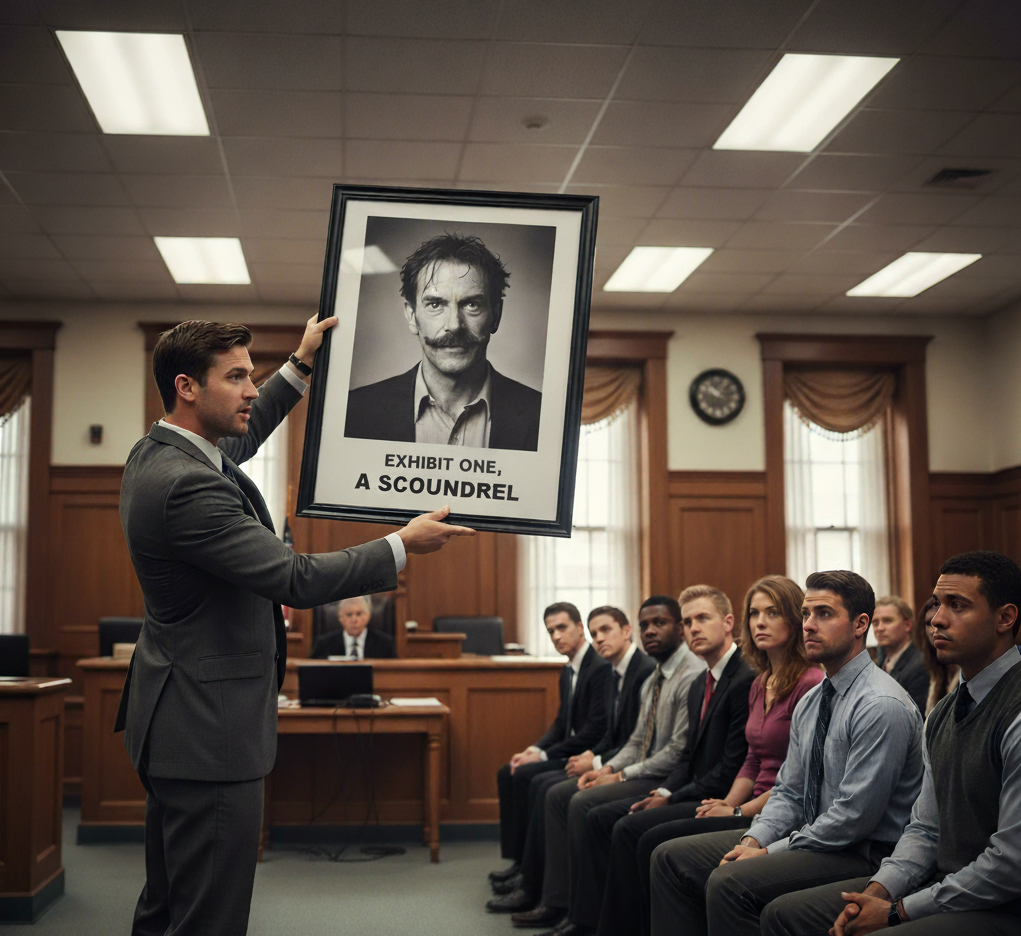
One of the best examples of “don't blame us, we didn't come up with this stuff” rulemaking involves the use of character evidence at trial. Character evidence is any evidence offered to prove that an individual is generally a good person or generally a rotten one. Sometimes it gets a little more granular than that, with evidence that a person is generally honest, or generally has a bad temper, but these traits are morally fraught and fairly slippery. So “is this guy good or bad" is generally the operative question.
One important thing to keep in mind is that character evidence plays a huge part in how most people resolve a huge number of factual questions in their daily lives. If you can't find your wallet, the question of “did my wife steal it?” is likely to be answered entirely by your assessment that she is honest. You're unlikely to review the surveillance footage or hunt for physical evidence. If two people you know tell you different stories about an event, you'll probably believe the one that you basically think is honest and disbelieve the one that you don't.
In the earliest jury trials at common law, character evidence may have played a substantial role. Professor Wigmore suggests, without much in the way of attribution, that “it is clear” that character evidence was admissible prior to 1670. [1] Professor Langbein, based on a more contemporary review of the Old Bailey Session Papers, concludes that the law was fundamentally unsettled on the topic throughout the 1600s and that the rule prohibiting character evidence was not consistently enforced until criminal defense counsel began appearing in large numbers in the 1780s. [2]
Why did courts start excluding this evidence? In one of the earliest reported examples, Hampden’s Trial, Judge Withins describes the matter as follows:
You know the case lately adjudged in this Court; a person was indicted for forgery, we would not let them give evidence of any other forgeries but that for which he was indicted, because we would not suffer any raking into men's course of life to pick up evidence that they cannot be prepared to answer to. [3]
And in Harrison's Trial, eight years later, Lord Chief Justice Holt similarly dismisses the evidence:
Hold, what are you doing now? Are you going to arraign his whole life?
Away, away! That ought not to be; that is nothing to the matter. [4]
The idea from the very get-go is not so much that character evidence is unreliable, but that there is something fundamentally unsporting about it. A person called into court as a defendant might be capable of defending themselves against specific charges but could hardly be expected to defend everything they had ever done in their life. There was also clearly some concern that a prosecutor could put a defendant on trial and absolutely tear them to pieces in front of a jury without ever really talking about the specific crime at issue.
So, courts started excluding character evidence as improper, if not quite irrelevant. But it very quickly became clear that a blanket prohibition was not really workable either. A defendant accused of theft, at least historically, generally wanted to be able to argue “It wasn't me, I'm an honest man, Ask anyone.” And there is also something unsporting about telling him that he can't, particularly in an age before forensic evidence or public investigation of crime, where it might very well be the only defense available to him.
But once again, a rule that the defendant can use character evidence but the prosecution can't can also start to rub courts the wrong way. “I didn't steal it, I'm an honest man,” says John the Thief, at his sixth trial for larceny in front of the same judge. Allowing one side to argue facts but not the other is a quick recipe for allowing arguments that are transparently false, not something that courts are too keen on.
There are also other complications that ultimately become apparent. If a person claims to have done something by mistake or not known what they were doing, is it character evidence to demonstrate that they did the thing intentionally in the past? And looming large over the issue of character is the idea of credibility. A jury's role, arguably its most important role, is to decide who is telling the truth and who isn't. Is it really possible to do that absent some knowledge about the people in question?
Against this backdrop of weird compromises, edge cases, and some notion of competitive fairness, the Advisory Committee had to draft some kind of rule. It acknowledged at the time that “its basis lies more in history and experience than in logic.” The rule was modified in the 1990s and then twice again in the early 2000s, but only to add additional weird exceptions and notice requirements and not as a clarifying exercise. In its current form, it reads as follows:
Character Evidence; Other Crimes, Wrongs, or Acts
(a) Character Evidence.
(1) Prohibited Uses . Evidence of a person’s character or character trait is not admissible to prove that on a particular occasion the person acted in accordance with the character or trait.
(2) Exceptions for a Defendant or Victim in a Criminal Case . The following exceptions apply in a criminal case:
(A) a defendant may offer evidence of the defendant’s pertinent trait, and if the evidence is admitted, the prosecutor may offer evidence to rebut it;
(B) subject to the limitations in Rule 412 , a defendant may offer evidence of an alleged victim’s pertinent trait, and if the evidence is admitted, the prosecutor may:
(i) offer evidence to rebut it; and
(ii) offer evidence of the defendant’s same trait; and
(C) in a homicide case, the prosecutor may offer evidence of the alleged victim’s trait of peacefulness to rebut evidence that the victim was the first aggressor.
(3) Exceptions for a Witness. Evidence of a witness’s character may be admitted under Rules 607 , 608 , and 609 .
(b) Other Crimes, Wrongs, or Acts.
(1) Prohibited Uses . Evidence of any other crime, wrong, or act is not admissible to prove a person’s character in order to show that on a particular occasion the person acted in accordance with the character.
(2) Permitted Uses . This evidence may be admissible for another purpose, such as proving motive, opportunity, intent, preparation, plan, knowledge, identity, absence of mistake, or lack of accident. [5]
The net effect of this rule and the ones that it cites is a bit of a mess. It heavily disincentivizes criminal defendants from testifying at trial without anyone explicitly declaring that as a policy goal.
How? Well, character evidence is normally inadmissible. Unless, of course, a criminal defendant dares to testify in their own defense, in which case the prosecution can introduce a mountain of it, including prior felony convictions, crimes of dishonesty, and random yahoos testifying that “in my opinion the defendant is a total liar,” or “in my opinion the victim was a saint.”
Most of this comes in under a theory of credibility, that it is necessary to admit character evidence when a defendant testifies because the jury needs to decide whether it believes him. But, as the Advisory Committee appears to have understood, this justification falls apart under the lightest scrutiny. A defendant may not take the witness stand in every case, but they are required to plead, and if a jury is involved it's because they pled “not guilty.” The whole purpose of a trial is for the jury to decide whether to believe the defendant’s plea or not. The idea that a defendant's credibility matters for peripheral issues (“did you owe the victim money?”) but not the central issue (“did you shoot the victim in the head?”) is hard to take seriously.
And even if you can draw some kind of principled distinction—likely some half-baked nonsense about burdens of proof and putting matters “at issue”—it's hard to believe that policing that distinction matters more than the punishing structural incentive not to testify that the current system produces. Leaving aside whether defendants should be induced to testify—the privilege against self-incrimination has a very odd history—it is absolutely bonkers to construct a criminal justice system that bends over backwards to ensure that juries don't get to hear the accused’s side of the story.
Crazy though that may be, it is still less crazy than the method that the Rules of Evidence authorizes to provide character evidence. Rule 405 is not exactly a model of scientific rigor:
Methods of Proving Character
(a) By Reputation or Opinion. When evidence of a person’s character or character trait is admissible, it may be proved by testimony about the person’s reputation or by testimony in the form of an opinion. On cross-examination of the character witness, the court may allow an inquiry into relevant specific instances of the person’s conduct.
(b) By Specific Instances of Conduct. When a person’s character or character trait is an essential element of a charge, claim, or defense, the character or trait may also be proved by relevant specific instances of the person’s conduct.
Mind you, these are the same rules of evidence that require the courts to “gatekeep” opinions from medical doctors and PhD research scientists if they are insufficiently “reliable.” Yet apparently any halfwit can testify that “in his opinion” a defendant is lazy or dishonest.
As civil practitioners, we thankfully do not need to muck about with character evidence with any frequency. But those who practice on the criminal side are forced to deal with the worst of all worlds, a rule that takes a normal aspect of human decision making, arbitrarily prohibits most of it, and then allows the remainder in a lopsided fashion that permits procedural rules to heavily influence substantive outcomes.
[1] John Henry Wigmore, A Treatise on the System of Evidence in Trials at Common Law Volume II § 1364 (1904).
[2] John H. Langbein, The Origins of the Adversary Criminal Trial, p. 192-196 (2003).
[3] Hampden's Trial, 9 How. St. Tr. 1053 (K.B. 1684),
[4] Harrison's Trial, 12 How. St. Tr. 833 (Old Bailey, London 1692).
[5] Fed R. Evid 404.