What Does it Mean to Open the Door?
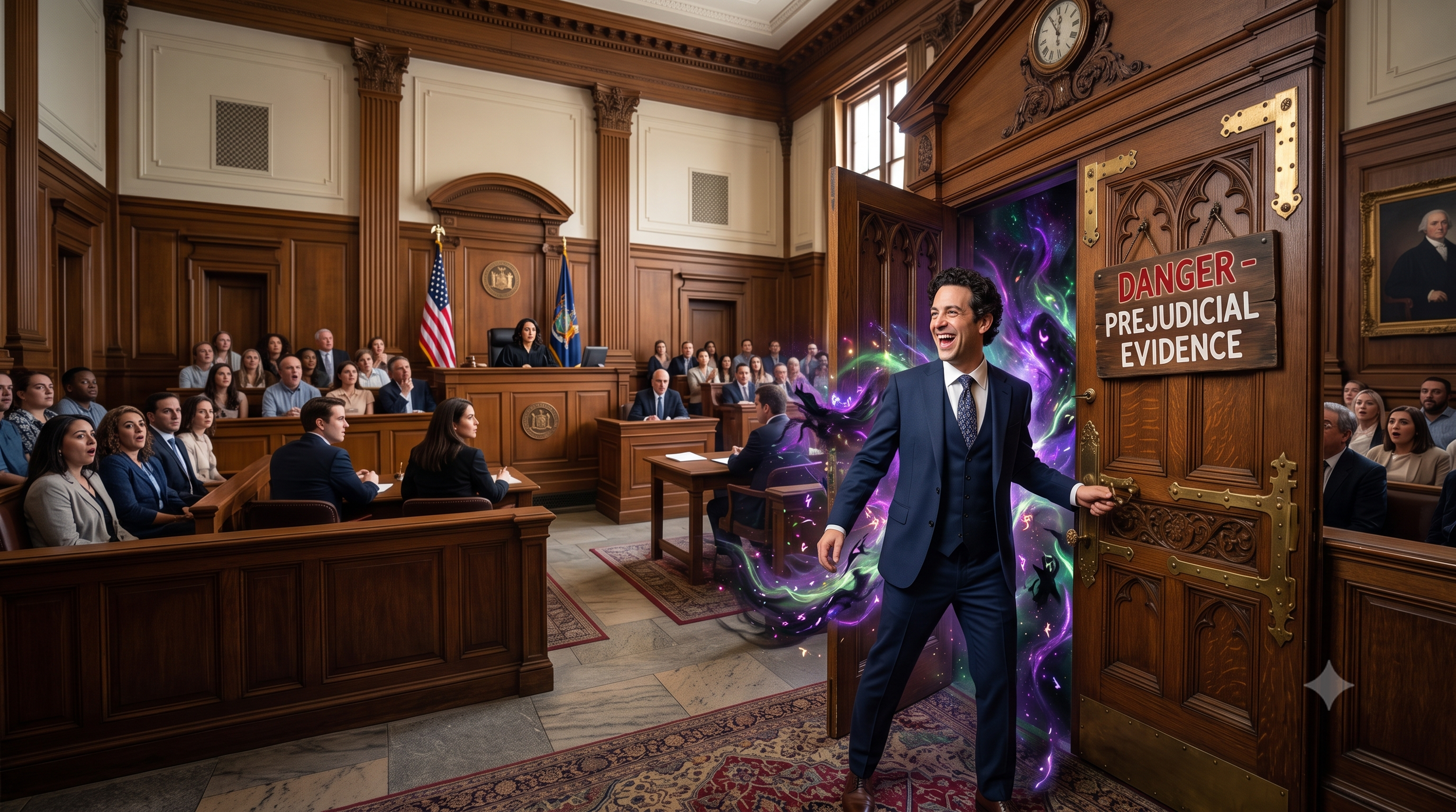
Any referee necessarily exercises some amount of discretion. The precise amount varies from sport to sport. A baseball umpire literally calls balls and strikes with every single pitch, whereas a soccer umpire may go half a match without any plausible opportunity to make a call. But there is always some discretion at play, and thereby some opportunity for fans to feel that the heavy hand of officiating is influencing the result.
Trials are played according to the rules of evidence (or sometimes the unofficial rules of evidence), a set of standards far more slippery and uncertain than those governing serious pursuits like football or ping pong. As such, even if your judge is honest and wise—and many are—you may find yourself in a courtroom governed by an unfamiliar, even alien set of restrictions, forbidden to make arguments or introduce evidence that you thought obviously fair game to your case. Nobody said trial was easy right? Time to reexamine your case and figure out whether your path to victory still goes through any of the same locations.
But whether you are licking your wounds at the exclusion of key evidence or celebrating your good fortune at a hamstrung adversary, it pays to remember that excluded evidence often finds its way into trial midway through. And sometimes the sudden introduction can make that evidence even more powerful than it would have been if permitted from the outset.
The mechanism is a series of doctrines often lumped together under the colorful name “opening the door.” In its most abstract form, the basic idea is that some action taken by the other side—a question, an argument, a bit of evidence or testimony—makes reference to the excluded evidence in a fashion that requires that the excluded evidence also be admitted. Whether this is grounded in completeness, fairness, or pure transgression and penalty depends entirely on where you are and whom you are in front of. But as a matter of pure heuristics, if one side mentions anything in the same general subject matter as excluded evidence that the other side wants in, you can expect the words “opened the door” to be uttered and the judge urged to permit the excluded evidence be admitted.
Even fairly scholarly trial judges rarely articulate the precise standards they apply when deciding whether a door has been opened and exactly how far. Academics and appellate courts that have written on the issue have identified at least three distinct doctrines at play, 1) the common law right of “specific contradiction,” 2) the evidentiary principle of “curative admissibility,” and 3) the rule of completeness. While related, they address slightly different issues and operate by slightly different rules.
Specific contradiction is the notion that any factual claim alleged by one party is subject to challenge or interrogation by the other. If a defendant claims to be a priest in his testimony, the plaintiff has the right to show that he is not a priest, even if ordination is not strictly relevant to the claims that have been asserted. Why? In part because any false statement made in court may undermine a witness's credibility. And in part because the party cannot reasonably claim that a fact is “irrelevant” after having actively asserted that fact to a jury.
Even at common law however, there were prudential limits on how far this rule could be pushed. Recognizing that trials could be substantially lengthened if parties were permitted to introduce unlimited evidence purely to impeach witnesses on irrelevant facts, courts adopted the distinction between “collateral” facts and those already relevant to the case. If a witness testified about facts relevant to the matter at issue, any witness testimony or evidence was admissible to contradict those facts. If the witness testified only as to “collateral” facts he or she could be impeached as to those facts while still testifying on the witness stand, but additional witnesses could not be called simply to contradict that testimony later.
The status of this doctrine in federal court is unclear. While not explicitly adopted by the federal rules of evidence, the right of specific contradiction may be implicit in the definition of relevance within FRE 401/402. In addition the notion of collateral facts can be seen in the approach taken by FRE 608, which allows for impeachment of a witness by prior bad act but not the use of extrinsic evidence to prove that bad act.
One bit to keep in mind is that specific contradiction does not require anyone to have done anything wrong. The fact to be refuted may be relevant or irrelevant, proper or improper, directly elicited by counsel or spontaneously offered by a witness. The point isn't punishment; it's the subjection of all factual claims to the appropriate scrutiny and avoiding potential mischief rather than punishing actual mischief.
In contrast, the principle of “curative admissibility” applies in situations where something improper has already occurred. Where a party violates an evidentiary ruling and introduces inadmissible evidence or argument into a trial, the court may permit additional, otherwise inadmissible, evidence to be admitted to “cure” or “refute” the prejudice. Unlike specific contradiction, this evidence does not have to directly address the specific factual claim, merely combat the prejudice that the improper evidence causes. For example if a civil plaintiff improperly makes reference to a defendant’s excluded criminal record, the defendant might seek to introduce his veteran status, his charitable acts, or other normally irrelevant character evidence to counteract the prejudicial impression created by plaintiff's statement. None of that evidence would “disprove” his criminal record in the strictest sense, but it would be more effective at potentially curing the prejudice then a mere instruction from the court that “the jury is not to consider the statement.”
The breadth of evidence potentially admissible under curative admissibility makes the doctrine potentially more flexible and more valuable than specific contradiction. But it also requires a much stricter showing to invoke. Unlike specific contradiction, which doesn't require that rules have been broken, a party seeking curative admissibility needs to show a breach. And even worse, curative admissibility also requires a showing that the prejudice of the rules violation would be better addressed by the excluded evidence than by an instruction. This is fundamentally a discretionary call. And it is one many judges would not be inclined to make given that they can simply assert that the jury will follow their curative instruction.
The third doctrine often mixed into the “opening the door” stew is the rule of completeness. This is the idea that if a party introduces a fact or a bit of evidence that, in isolation, might create a misleading impression, the other party may introduce such facts as necessary to put the original fact in context. Like curative admissibility, the focus of the rule of completeness is in remedying potential unfairness rather than directly refuting a fact. But the scope of admissibility is much more narrow, aimed at avoiding inaccurate or unfair factual determinations rather than more nebulous prejudicial infirmities. But unlike curative admissibility, a party seeking to introduce evidence via the rule of completeness does not need to show the violation of a rule or other wrongful act by counsel. Rather the party need only show that the partial admission of evidence creates the possibility of a misleading impression that could be corrected by further context.
In practice the three doctrines tend to blend together, not the least because courts often conflate them and/or fail to identify which rule they are employing when ruling that a party has “opened the door.” Because of this it often pays to feel out what a judge seems to think is important when opening the door comes up. Does he or she seem focused on fairness? Prejudice? “Gotcha” style violation of prior orders? As with hearsay exceptions many judges are particularly sympathetic to certain evidentiary arguments and if you can spot them early you can often get evidence admitted through doors that might otherwise be deemed closed.
Conversely, if you've excluded the other side's best piece of evidence, you have to expect that they'll spend the whole trial trying to find a way to sneak it in. Unless you want them to succeed, take the time to think like they will. How would you try to get the evidence in if you were them? What errant arguments or testimony would you latch on to to argue that the door had been opened? Once you have that, prep your witnesses and scrub your outlines to eliminate anything that the other side can use. This often means banning certain words from your vocabulary and telling witnesses to stay far away from certain topics. It also means being ready to argue that whatever is claimed to have opened a door is not prejudicial, was not foreclosed by the court's ruling, does not create a misimpression, and/or can be addressed by a curative instruction.
Door opening is one of the most exciting parts of trial and serves to keep lawyers on their feet. But by understanding what's going on and thinking about how doors might be opened before they are, you can give yourself a leg up on the often-unpredictable evidentiary landscape.