Do Jury Instructions Matter?
.
We've written before about what kind of cases actually go to trial. It's a good thing to keep in mind if you are someone who handles complex commercial disputes, patents, or any other type of case that is frequently settled before trial. Your vision of a trial is invariably colored by the types of cases you do. To a patent lawyer a trial is necessarily going to involve days of technical testimony from many hired experts. A commercial litigator expects a hundred emails to go into evidence. But when a judge or a jury imagines what a trial is going to look like, they're thinking about a short trial involving a car crash or a drug sale. What feels normal to you is not going to feel normal to them.
We looked at state level data when analyzing the types of cases that go to trial, but one other way to get a rough sense of it is to flip through pattern jury instructions. In New York the Pattern Civil Jury Instructions (“PJI”) take up two books, but the first one is solely devoted to negligence. Personal injury is most of the business of civil jury trials most of the time and because of that there are elaborate, well developed pattern jury instructions for those cases so that judges and lawyers do not have to draft their own.
Someday I'll have a case where can just copy/paste six or seven PJI statements into a document and call it a day. But more often I'm either dealing with a business dispute with complex facts and bespoke legal defenses or statutory claims that don't get tried nearly as often—like the federal whistleblower statute that applies only to railway safety issues. And that means drafting jury instructions and trying to convince the court to use your draft rather than whatever madness the other side has put to paper.
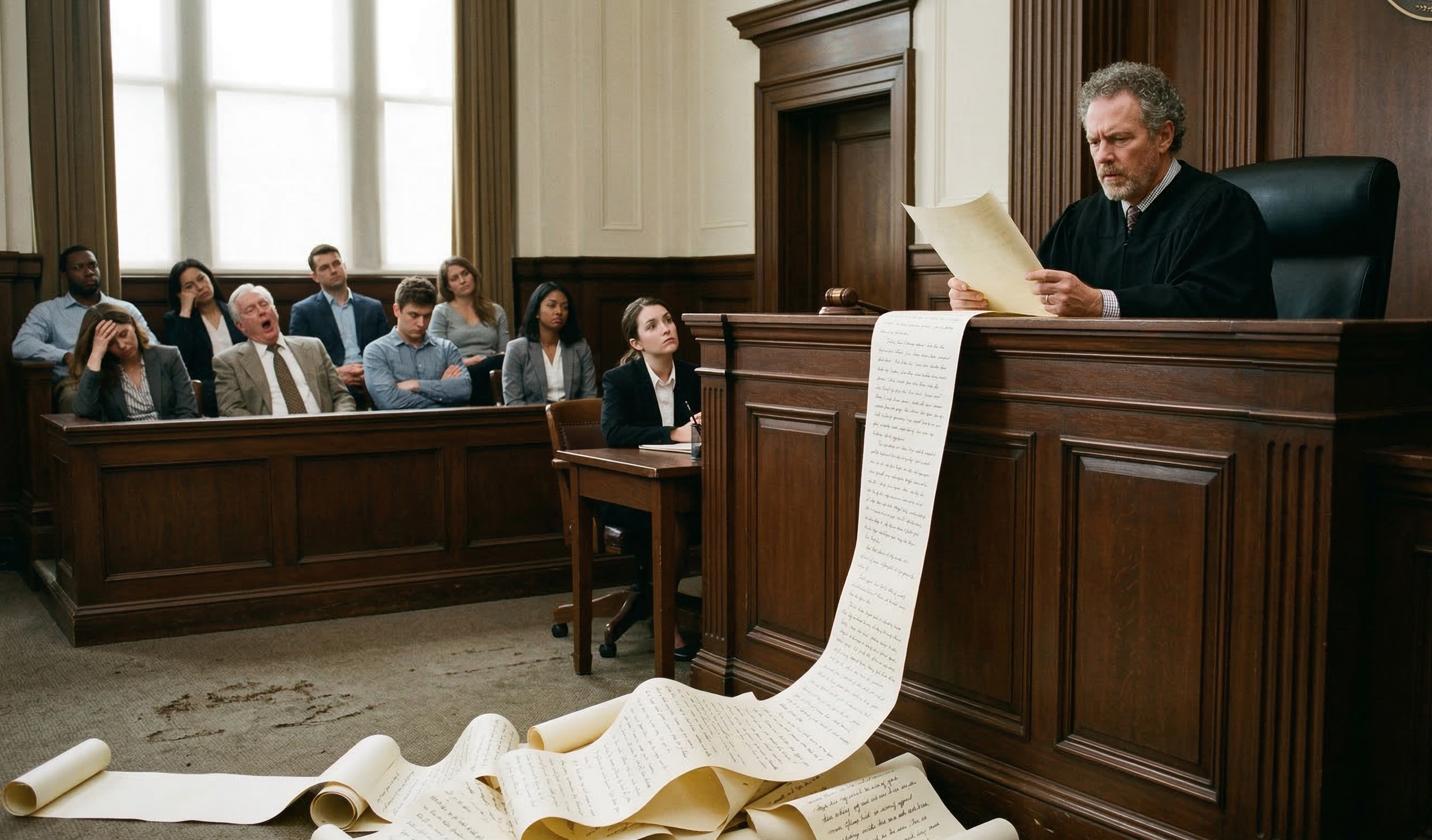
It's a lot of work and looking at the result you might wonder whether it's worth it. Prior to the beginning of deliberations the judge will read the instructions to the jury, a process that can take an hour or more. Even by the standards of jury duty—which can involve sitting in windowless rooms for extended periods of time—jury instructions are duller than dirt and even the most civic minded jurors often look pained by being forced to listen to it. As such, you might honestly wonder whether jurors can meaningfully glean anything from the long boring speech.
On some level the belief that jurors understand and correctly apply instructions is a fundamental conceit of the justice system. In criminal cases, mistakes and jury instructions are frequent grist for appeal and new trials. And as we've written before the court system bends over backwards to make it difficult to interrogate the jury's deliberations. This means turning a blind eye to whether they correctly followed the instructions or for that matter even considered them. All of this suggests that the instructions are critically important and will certainly influence the result.
Because of those assumptions, social scientists have been studying the issue for decades. The results range between disturbing and horrifying. For example, in 1975 researchers in Florida conducted a study on individuals called for jury service but not selected. [1] Half the participants were shown videotaped jury instructions and the other were not. Then everyone was given a multiple-choice test to evaluate whether they understood the law. While jurors who viewed the video did tend to score higher, the overhaul comprehension rate for instructed jurors was scarcely 70%. And on some key issues like presumption of innocence, the instructed jurors were no better than a coin flip at 50%. Only 57% believed that a case could be proven by circumstantial evidence. This was despite receiving a detailed circumstantial evidence instruction.
A 1977 study was even more stark, finding that after receiving instructions only 30% to 35% of jurors could accurately apply the law to a mock fact pattern. [2] And a 1990 study testing actual jurors’ comprehension after the fact found that for some questions the instructed jurors actually did worse than the control group and were less likely to apply the law correctly. [3] This tends to support the belief by many practitioners that jurors often misunderstand or misapply the instructions that they hear. Confusing instructions may be worse than boring—they may actively introduce error into the proceedings.
Why is this the case? Social science researchers have pointed out the disconnect between instructions and the people receiving them. Judges and lawyers drafting jury instructions want to avoid reversal in retrial and have strong incentives toward drafting overwrought instructions that maximize strict factual accuracy at the expense of comprehensibility. Also, once an appellate court has blessed in instruction as an accurate statement of the law, few lower courts will tinker with it, no matter how awkwardly it reads.
And while the average juror is not an imbecile or a fool, the average literacy rate in the United States is substantially below the 12th grade or higher level at which jury instructions are often written. Jurors who may be perfectly capable of judging witness credibility or deciding disputed facts may still be utterly incapable of parsing complex legal arguments—particularly if delivered as a long uninterrupted lecture.
This isn't to say that they don't try. The fact that instructions influence jury results—albeit sometimes in the wrong direction—suggests that many jurors at least attempt to listen and understand. So, you can't simply write off during instructions as a pointless exercise and totally phone them in. But neither can you assume that model jury instructions, even those blessed by an appellate court, will necessarily be understood by the folks in the jury room period
As such it is important to review proposed instructions with an eye toward where jurors may go off the rails. Three frequent culprits for confusing juries are “burden of proof,” “causation,” and “circumstantial evidence” instructions. In most cases these concepts are not genuinely complex, but the model instructions written to explain them often make them so, stuffing them with all sorts of odd jargon and focus on unusual and analytically unsound concepts like “direct vs. indirect evidence”, “but-for vs. approximate causation,” and other legal anachronisms that would get you laughed out of a freshman philosophy class but are breathlessly explained to juries as though they were the wisdom of the ancients.
Once you've found the troublesome instructions, the question is what to do about them. The first step is to shop around for every model instruction that you can find. You’re hoping to locate one written in English or at least the closest approximation. If that doesn't work, you can hunt through prior case records or look to other jurisdictions. Writing your own is the best approach of course but will likely face at least some resistance from the other side or the court. At least one of them is virtually bound to push for incomprehensible gibberish.
If all else fails and the instructions are a bear, be prepared to clean them up as best you can in closing argument. This can be tricky—some courts are very touchy about attorneys “instructing” the jury on the law rather than arguing the facts of the case. But the two bleed at the edges and you can usually do some explanation in the guise of “applying the law to the facts.” And worst comes to worst, remind the jury that the law is not supposed to lead to unusual or unfair results and that if they believe that the instructions require that to happen, they should ask questions about the instructions to verify that they understand them properly. You have to be careful of course—you don't want to be arguing for jury nullification—but telling the jury to verify that they're following the law as directed by the court is generally pretty safe.
In the early colonial period, there were no jury instructions, and it was assumed that jurors could render verdicts without a long confusing lecture on “inferences” and “reasonable care” from the judge. As we are unlikely to return to such a civilized way of doing things, it pays to understand the limitations of our current system of jury instructions and to take such steps as are necessary to ensure that the jury has what it needs to nevertheless render a just result.
[1] David U. Strawn and Raymond W. Buchanan, Jury Confusion: A Threat to Justice, 59 Judicature 478 (1976).
[2] Elwork, A., Sales, B., & Alfini, J. Juridic decisions in ignorance of the law or in light of it. Law and Human Behavior, 1, 163-189. (1977). doi: 10.1007/BF0153437
[3] Geoffrey P. Kramer and Dorean M. Koenig, Do Jurors Understand Criminal Jury Instructions? Analyzing the Results of the Michigan Juror Comprehension Project, 23 U. Mich. J.L. Reform 401 (1990).